
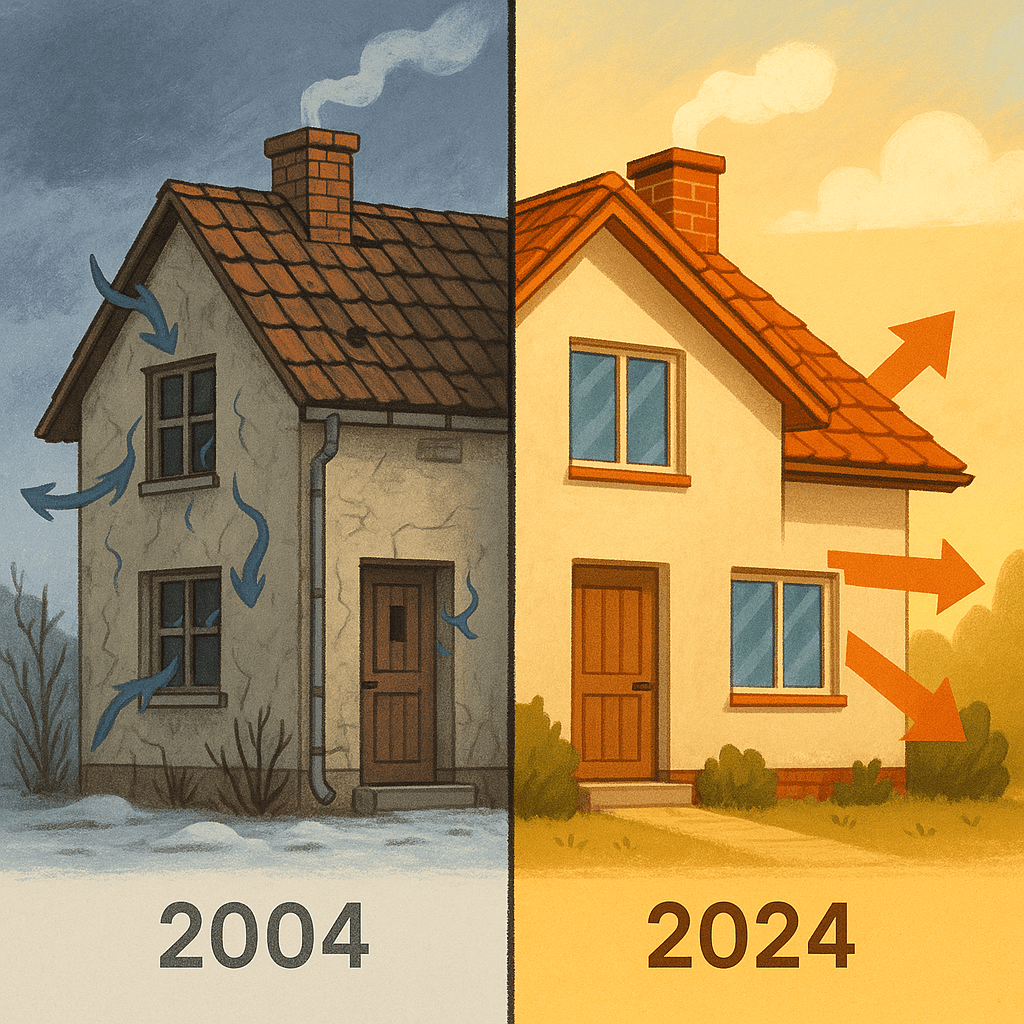
🎉 Looking Back: 20 Years of Part L Compliance
In 2005, HIBEC was born out of the EU Directive on the Energy Performance of Buildings. Our mission? Help the UK construction sector comply with Part L of the Building Regulations—a bold legislative push to reduce carbon emissions and improve energy efficiency.
Fast-forward 20 years, and we’re asking ourselves the big question:
Has it all been worth it?
🔍 The Aim of Part L
At its core, Part L was meant to do four things:
- Improve thermal performance of buildings
- Ensure better build quality
- Push manufacturers to produce more efficient services
- Encourage smarter control systems for heating, lighting, and more
So—how much real-world progress have we made?
🧪 Our Experiment: 2005 vs. 2025 Specs
To find out, we ran a quick internal test. Here’s what we did:
✅ Method:
- Selected 3 common dwelling types:
- 🏠 Mid-terraced 2-bedroom
- 🏡 3-bedroom semi-detached
- 🏘️ 4-bedroom detached
- Retrieved 2005-compliant specifications from our archives
- Ran them through 2025 SAP software
- Re-ran the same dwellings with 2025-compliant specifications
❌ One Big Rule:
We excluded solar panels and renewables from both versions.
Why? Because in the early days, many developers relied on PV panels as a shortcut to compliance—sidestepping deeper improvements to fabric or systems. That loophole has since been closed, and we wanted this test to focus on the real building advancements.
📊 Results: The Evolution in Efficiency
Spoiler: Yes, it’s worked—and here’s the data to prove it.
Chart 1: SAP Score Comparison (2005 Specs vs. 2025 Specs)
| Dwelling Type | 2005 SAP Score | 2025 SAP Score |
| 2-bed mid-terrace | 75 | 81 |
| 3-bed semi-detached | 75 | 81 |
| 4-bed detached | 56 | 82 |
🧠 Insight: Across all three dwellings, SAP scores improved significantly—driven entirely by better building envelopes and more efficient services.
Chart 2: CO₂ Emissions (kgCO₂/m²/year)
| Dwelling Type | 2005 Emissions | 2025 Emissions |
| 2-bed mid-terrace | 25.83 | 4.61 |
| 3-bed semi-detached | 26.26 | 4.49 |
| 4-bed detached | 24.83 | 3.55 |
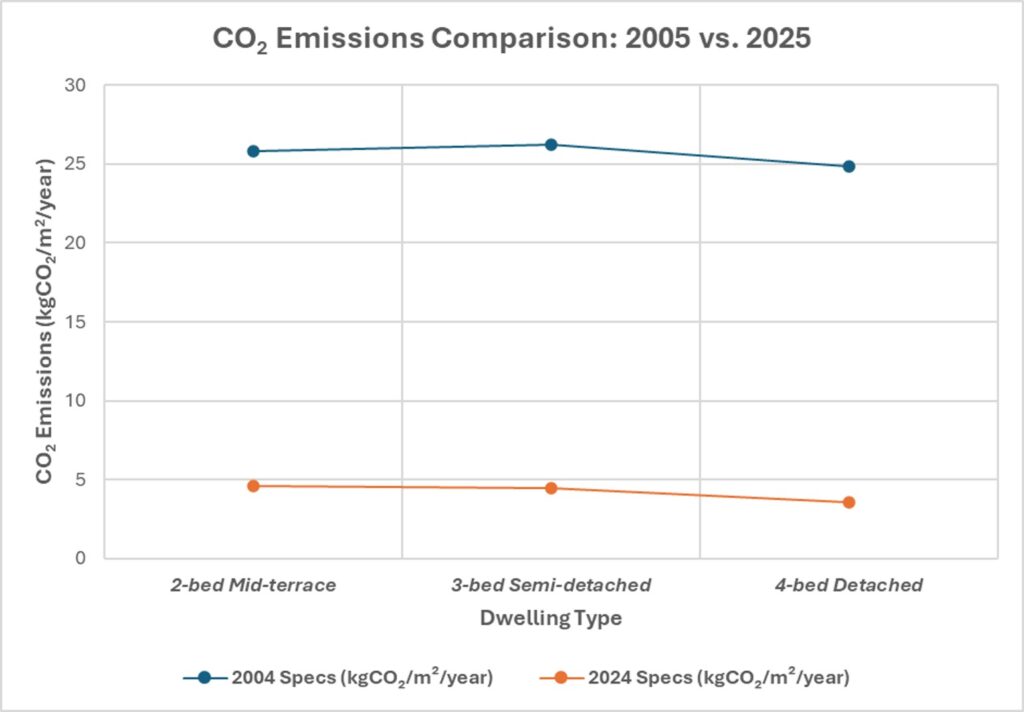
CO₂ emissions per square meter have dropped dramatically from 2004 to 2024 specification standards for all UK dwelling types under updated SAP and Part L regulations.
🌍 Takeaway: Emissions have reduced by more than 80% in two decades—even without renewables. That’s a big win for sustainable housing.
🔧 What Changed?
Here are the biggest differences driving those improvements:
- U-Values: Significant reductions across walls, roofs, and floors
- Thermal Bridging: More detailed modeling and better detailing
- Air Tightness: Stricter targets and widespread blower door testing
- Plant Efficiency: Condensing boilers, ASHPs, and better hot water storage
- Lighting & Controls: LED adoption, zonal heating, smart thermostats
🗣️ Final Thoughts: Was It Worth It?
In our view? Absolutely.
It’s been a journey—sometimes frustrating, often complex—but ultimately transformative. The days of compliance through solar “add-ons” are behind us. Today, homes are genuinely better: warmer, more efficient, and ready for a lower-carbon future.
At HIBEC, we’re proud to have played a role in that shift.
Here’s to the next 20 years of building smarter, not just by regulation—but by design.
📥 Want the Full Specs?
Curious about the exact inputs we used for our test homes?
📧 Get in touch, and we’ll be happy to share them.